Water Softener Salt Level: How Much Salt Should Be in Your Brine Tank?
Quick Answer: How Much Salt Should Be in a Jason’s Water Softener?
Check the salt level by removing the lid from your Jason’s brine tank and comparing the salt to the marked line on the outside of the tank.
If the water softener salt level is well below that line, add salt until it reaches the marked level. Do not fill the brine tank above the line. Jason’s recommends adding approximately two to three 40-pound bags when a refill is needed, depending on how low the tank is.
Rather than relying on a generic “half-full” rule, follow the fill indicator designed specifically for your Jason’s system.
Key Takeaways
- Use the marked line on your Jason’s brine tank. If the salt level falls well below the line, add more salt without filling past the indicator.
- Check your salt level regularly. Water hardness, water consumption, regeneration frequency, and household usage all affect how quickly your system uses softener salt.
- Low salt does not always mean your water softener is broken. If hard water symptoms suddenly return, checking the brine tank is one of the easiest troubleshooting steps you can take before requesting service.
If your water suddenly does not feel as soft as it normally does, your first thought may be that something is wrong with your water softener.
Before assuming you need a repair, check something much simpler: the salt level in your brine tank.
Your water softener needs salt to complete the regeneration process that keeps the softening media ready to remove calcium and magnesium from your water. If the salt gets too low, the system may eventually lose its ability to consistently provide soft water.
For a Jason’s Water System, checking the salt is especially simple because the brine tank includes a clearly marked fill line showing you where the salt level should be.
Why Does a Water Softener Need Salt?
A water softener uses a process called ion exchange to reduce the hardness minerals in your water.
As hard water passes through the softening media, calcium and magnesium ions are exchanged on the resin beads. Eventually, those resin beads need to be cleaned and recharged so the water softener can continue doing its job.
That is where the brine tank comes in.
The salt inside the tank combines with water to create a concentrated brine solution. During a regeneration cycle, that solution passes through the softening media and helps remove the accumulated hardness minerals from the resin.
Jason’s describes the brine tank as the part of the system that stores the salt needed to create this regeneration solution. Without enough salt available, the system cannot complete that process properly.
What Happens When Your Water Softener Runs Low on Salt?
You may begin noticing familiar hard water symptoms again.
In Emily’s video, one of the first clues was how the water felt during her morning shower. Her skin felt dry and itchy and her hair did not feel the way it normally did with softened water.
Other signs can include:
- Water spots appearing on dishes
- Soap not lathering as well
- White mineral buildup returning around faucets
- Scale beginning to appear on fixtures
- Water no longer feeling as soft
- Hard water residue returning in showers or sinks
These symptoms do not automatically mean the unit has failed.
If the system does not have enough salt to create the brine needed for regeneration, calcium and magnesium can eventually begin passing through again.
That is why checking your water softener salt level should be one of your first troubleshooting steps.
How to Check the Salt Level in a Jason’s Water Softener
Checking a Jason’s brine tank only takes a few moments.
1. Remove the Brine Tank Lid
Open the lid and visually inspect how much salt remains in the tank.
2. Find the Marked Salt Line
Jason’s brine tanks include a clearly marked line indicating the proper salt level for the system.
3. Compare the Salt to the Line
If the existing salt is far below that indicator, it is time to add more.
4. Add Salt to the Marked Line
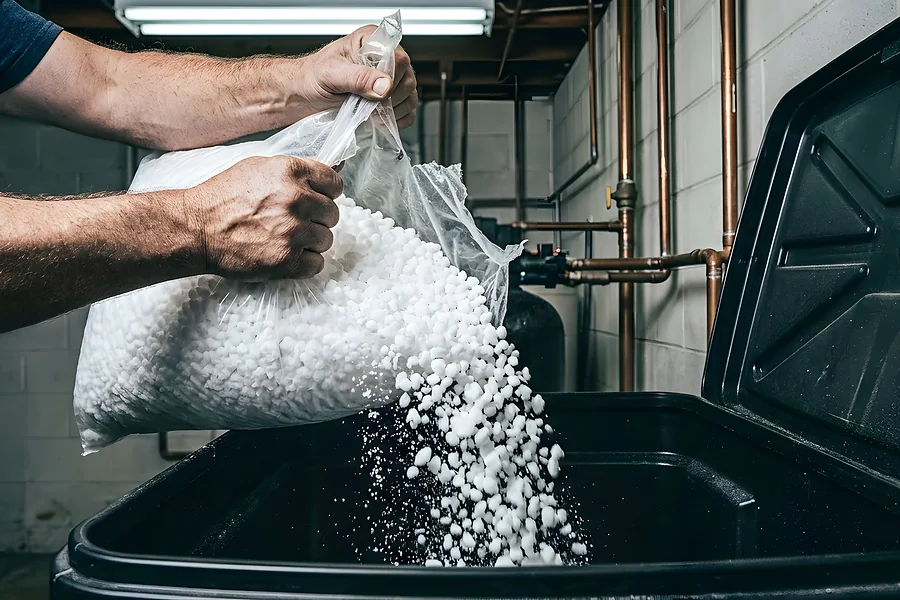
Pour additional softener salt into the brine tank until it reaches the designated line.
Do not fill above it.
Jason’s maintenance instructions generally suggest adding two to three 40-pound bags at a time when the brine tank needs to be replenished. The actual quantity you need depends on how much salt remains when you check it.
How Often Should You Check Your Water Softener Salt Level?
A good habit is to check the brine tank about once a month.
That does not mean every Jason’s system will need salt every month.
Salt usage depends on several factors, including:
- Your water hardness level
- How much water your household consumes
- Family size
- System settings
- How frequently the unit needs to regenerate
A household with very hard water and high water consumption may use salt more frequently than a smaller household with lower usage.
Jason’s recommends checking levels regularly rather than assuming every home should follow the same refill schedule.
What Type of Salt Should You Use in a Jason’s Water Softener?
Jason’s Water Systems can accommodate multiple types of softener salt, but our maintenance guidance recommends using salt pellets rather than salt crystals.
Pellets generally last longer in the brine tank and can help reduce some of the residue associated with lower-quality salt.
For homeowners looking for a high-purity option, evaporated salt pellets are a preferred choice. Evaporated salt is one of the purest forms of sodium chloride commonly sold for water softeners and produces less insoluble material than less-refined options such as rock salt.
Jason’s specifically identifies evaporated salt pellets as its preferred type because their low level of insoluble material helps reduce buildup and the likelihood of salt bridges.
You can learn more in our guide to the best salt for water softeners.
What About Solar Salt or Potassium Chloride?
Solar salt is another type of water softener salt commonly available in stores. It is produced through evaporation and is generally less refined than evaporated salt pellets.
Potassium chloride can also be used as an alternative to sodium chloride in some water softeners.
However, you do not need to choose a specialty product simply because it costs more.
Jason’s systems are designed to work with a variety of salt options. For normal maintenance, the most important thing is using an appropriate pellet-style softener salt and keeping enough of it in the brine tank for the system to regenerate.
If you are unsure what to buy for your specific unit, call Jason’s before adding it.
What Is a Salt Bridge?
Sometimes a brine tank can appear to contain plenty of salt even though the system is not able to use it properly.
A salt bridge is a hardened layer of salt that forms inside the brine tank. Instead of loose pellets moving down toward the water and forming the necessary brine solution, the hardened salt can create an empty space underneath.
From above, the tank may look full.
But the water softener may not actually be receiving the salt it needs.
Using good-quality salt pellets can help reduce the likelihood of salt bridges and other insoluble buildup.
If your salt level looks correct but hard water symptoms continue, contact Jason’s rather than continually adding more salt.
How Does Your Jason’s Water System Know When to Regenerate?
Jason’s Water Systems are designed to automatically manage regeneration based on system operation rather than requiring homeowners to manually start the cleaning process every time.
During regeneration, the brine solution cleans and recharges the softening media so it can continue removing hard minerals from incoming water.
On Jason’s newer touchscreen controls, homeowners may also see a Low Salt Level warning. After adding salt, the controller allows the total amount of salt in the brine tank to be updated so the system can continue tracking usage.
Your system settings matter too.
Water hardness, gallon usage, regeneration settings, and other factors can affect how frequently the water softener runs through a regeneration cycle.
Why Your Water Hardness Affects Salt Usage
Two homes with the same Jason’s Water System may not use exactly the same amount of salt.
One reason is water hardness.
Hard water contains calcium and magnesium. The more hardness minerals the softening media needs to remove, the greater the demand placed on the system.
Water consumption also matters.
An average family using more gallons of water will generally require the system to treat more water than a household with lower consumption.
That is why Jason’s does not rely on one universal quantity of salt for every house.
Your system needs to be calibrated around the actual conditions in your home.
If you do not know your hardness level, Jason’s offers a free water test to help determine what is in your water.
What If Adding Salt Does Not Bring the Soft Water Back?
If your tank was low, refill it to the correct line and give the system an opportunity to complete its normal regeneration process.
If hard water symptoms continue, do not keep adding salt above the fill line.
Another issue may be affecting the unit.
Possible problems can include:
- A salt bridge
- Incorrect hardness settings
- A regeneration issue
- Brine tank debris
- Valve problems
- Softening media that needs service
- System calibration issues
Jason’s technicians can inspect the system and determine why it is not producing the water quality you normally expect.
Our Annual Maintenance Program includes brine tank sanitation, resin cleansing, valve checks, calibration, and a review of settings including hardness, regeneration, and gallon usage.
Water Softener Maintenance Does Not Have to Be Complicated
Checking your salt is one of the simplest things you can do to keep your water softener operating properly.
You do not need to calculate exactly how many pounds an “average family” should use or worry because your neighbor adds salt more or less frequently than you do.
For a Jason’s Water System, keep it simple:
Open the lid. Check the marked line. Add pellets when needed. Do not overfill it.
Jason’s also provides water softener maintenance videos showing customers how to check their brine tank, refill salt, reset salt warnings, use the bypass, and perform other basic system tasks.
Is Your Water Starting to Feel Hard Again?
Before assuming your water softener needs a repair, take a look inside the brine tank.
A low water softener salt level can be an easy problem to identify and correct. If adding salt does not solve the issue, Jason’s Water Systems is here to help.
Our technicians can answer questions over the phone, troubleshoot your system, or come to your home to inspect and service your equipment.
Contact Jason’s Water Systems or request service today to get your system back to producing the soft water you expect.
Frequently Asked Questions
How much salt should I put in my Jason’s Water Softener?
For a Jason’s Water System, use the marked salt-fill line on the brine tank rather than relying on a generic half-full or two-thirds-full rule. Add salt when the level gets low, but do not fill above the indicated line.
How often should I check my water softener salt level?
Check the salt level regularly as part of routine maintenance. In a hard-water area like San Antonio, checking approximately every 2 to 4 weeks can help you catch a low salt level before hard water symptoms start returning.
What type of salt should I use in a Jason’s Water Softener?
Jason’s recommends water softener salt pellets rather than crystals. High-purity evaporated salt pellets are a good option because they contain fewer impurities that can accumulate inside the brine tank.
What does “high-purity” water softener salt mean?
High-purity softener salt generally contains at least 99.5% sodium chloride. Evaporated salt pellets are among the purest options, commonly ranging from approximately 99.7% to 99.99% purity. Using cleaner salt can help reduce insoluble material and maintenance issues inside the brine tank.
Should I use rock salt in my water softener?
Rock salt is one of the least refined types of softener salt and contains more insoluble material than higher-purity options. Those impurities can contribute to sediment or sludge in the brine tank, which is why higher-purity pellets are generally a better choice for a Jason’s system.
Can I use solar salt in my water softener?
Solar salt can be used in many water softeners and is often less expensive than evaporated salt. However, it is generally less pure and may contain more insoluble material. For Jason’s systems, we recommend pellet-style softener salt and suggest contacting our team if you are unsure which product to purchase.
Does my water softener tell me when the salt is low?
Some modern water softeners include a low-salt warning on the digital control panel. Certain Jason’s controls can also track salt usage. Even with a digital reminder, it is still a good idea to visually check the brine tank periodically.
What happens if my water softener runs out of salt?
Without enough salt, the system cannot produce the proper brine solution needed to regenerate the resin beads. As the softener loses its ability to remove calcium and magnesium ions, you may begin noticing hard water symptoms again, such as water spots, mineral buildup, poor soap lathering, or water that no longer feels as soft.
How long does it take to get soft water again after adding salt?
Adding salt does not necessarily make the water soft again immediately. The system typically needs to complete a regeneration cycle so the brine solution can recharge the resin beads. Rather than promising a universal 2–3 day timeframe, I’d tell Jason’s customers to contact the team if soft water does not return after the system has had an opportunity to regenerate.
What is a salt bridge?
A salt bridge is a hardened layer of salt inside the brine tank. It can make the tank look like it has plenty of salt even though the salt is no longer reaching the water below to create a proper brine solution. If your tank appears full but hard water symptoms have returned, a salt bridge may be one possible cause.
Does San Antonio’s hard water make my water softener use more salt?
It can. The harder the incoming water is, the more calcium and magnesium the system has to remove. Water consumption, family size, hardness level, and regeneration settings can all affect salt usage, which is why two households may refill their brine tanks at different rates.